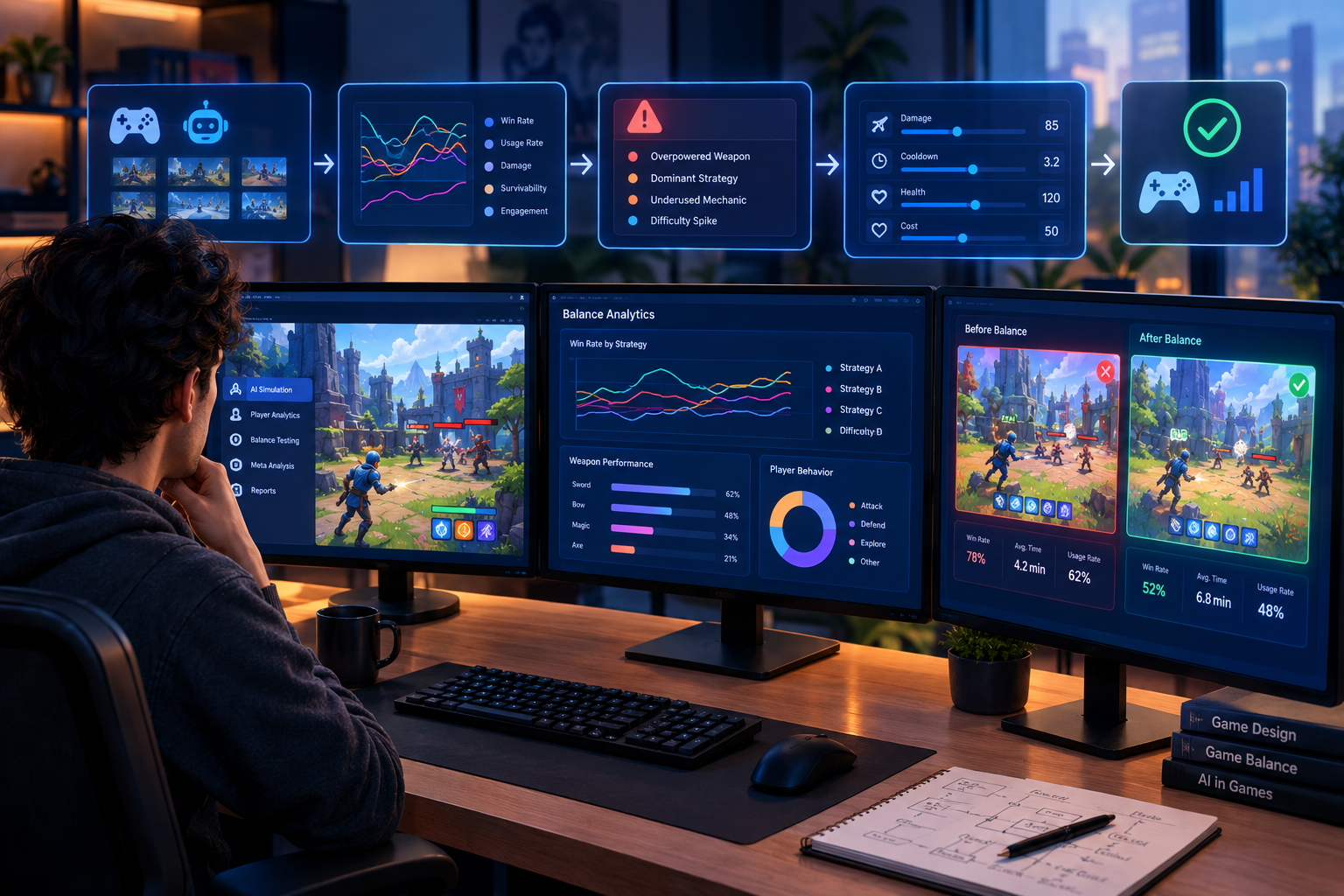
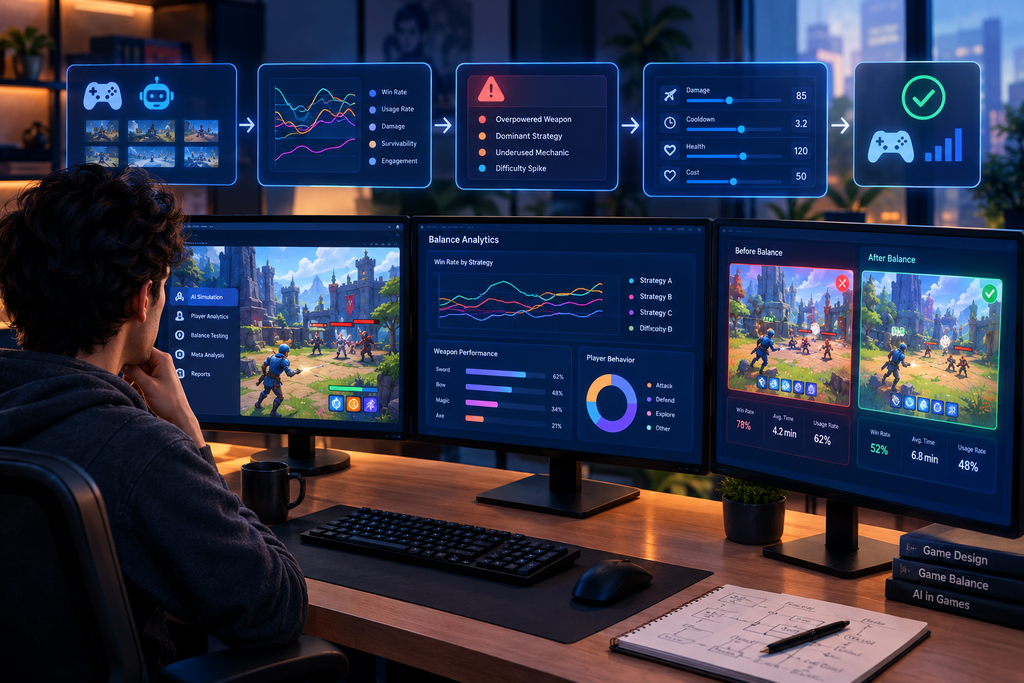
Game balance is one of those things players rarely praise when it’s done well but complain about constantly when it isn’t. A weapon that’s slightly too strong, a difficulty spike that comes out of nowhere, a strategy that dominates every other approach, these issues can undo months of otherwise solid design work. Getting balance right has always required extensive testing across countless scenarios, which is exactly the kind of repetitive, data-heavy work that AI is now helping developers handle far more efficiently.
Why Balance Is So Difficult to Get Right
Small Numbers Create Large Effects
Balance problems rarely come from obvious design flaws. They usually come from small numerical decisions, a slightly too generous cooldown, a marginally underpriced item, that compound into something noticeably unfair once players discover how to exploit them. These issues are often invisible until enough people have played enough hours to find the edge cases.
Players Will Always Find the Optimal Path
No matter how a system is designed, players collectively tend to find the most efficient strategy faster than any internal testing team can predict. What looks balanced across a handful of playtests can completely fall apart once a much larger, more determined player base starts searching for advantages.
How AI Helps Identify Balance Issues Faster
Simulating Large Volumes of Play Before Launch
AI-assisted tools can simulate far more play sessions than a small internal team could ever manually test, surfacing patterns like overused strategies or underused mechanics long before a game reaches real players. This doesn’t replace human testers, but it catches a lot of obvious problems earlier in development.
Spotting Dominant Strategies Early
One of the most useful applications of AI in balance testing is identifying when a single strategy consistently outperforms all reasonable alternatives. Instead of waiting for players to discover and exploit this after launch, developers can catch these patterns while adjustments are still cheap to make.
Testing Numerical Adjustments Quickly
Rather than manually tweaking one variable and waiting through a full testing cycle to see the effect, AI-assisted tools let developers test several numerical adjustments in quick succession, comparing outcomes to find a range that actually produces balanced results.
Turning Balance Data Into Real Adjustments
Identifying a balance problem is only half the job. Developers still need a fast way to make an adjustment and confirm it actually fixed the issue without creating a new one elsewhere.
Why Speed of Implementation Matters for Balance Work
Balance is rarely solved in a single pass. It usually takes several rounds of small adjustments, each one tested against the same scenarios that revealed the original problem. If each adjustment takes a long time to implement and test, the overall balancing process slows down considerably.
A Platform Built Around Fast Balance Iteration
Astrocade is a good example of an AI game maker that supports this kind of quick adjustment cycle, letting developers change a variable and see it reflected in a playable build almost immediately, which keeps the balancing process moving instead of stalling on implementation overhead.
Seeing Balance Work in a Real Game
Obliterate Earth is a good example of a game where balance directly shapes whether the core experience feels fair and satisfying. Games built around direct competition or combat rely heavily on this kind of tuning, since even small imbalances become obvious the moment players start comparing strategies against each other.
What Developers Still Need to Judge Themselves
Deciding What “Balanced” Actually Means for a Game
Perfect mathematical balance isn’t always the goal. Some games benefit from asymmetry, where different strategies feel distinct rather than equally powerful, and deciding how much imbalance is intentional versus a genuine problem is a judgment call AI data alone can’t make.
Weighing Fun Against Fairness
A perfectly balanced system on paper can still feel dull if every option performs identically. Developers need to decide where a little imbalance actually makes the game more interesting, rather than chasing pure statistical equality at the expense of variety and personality in different strategies.
Recognizing When Data Doesn’t Reflect Real Player Behavior
Simulated testing can miss the unpredictable, creative ways real players actually approach a game. Developers still need to validate AI-surfaced balance issues against genuine player feedback rather than assuming simulated data tells the complete story.
Common Mistakes When Using AI for Balance Testing
Over-Relying on Simulated Data Alone
Simulated testing is a powerful early filter, but it doesn’t fully replace real playtesting. Some balance issues only become clear once actual players, with their unpredictable habits and creativity, get their hands on a system.
Chasing Perfect Symmetry
Not every imbalance is a problem worth fixing. Developers who treat every statistical difference between options as something that must be corrected can end up flattening a game’s variety in the name of balance that players never actually asked for.
Making Too Many Changes at Once
Adjusting multiple variables simultaneously makes it difficult to know which specific change actually fixed or worsened a balance issue. Isolating one adjustment at a time produces far clearer, more reliable results.
A Practical Approach to AI-Assisted Balance Work
A reasonable process looks like this. Use AI-assisted simulation early to identify obvious dominant strategies or underused mechanics before real players ever encounter them. Test numerical adjustments in small, isolated steps rather than changing several variables at once, so the effect of each change is clear. Bring in real playtesters once simulated data suggests a system is close to balanced, and treat their reactions as the final check rather than relying solely on statistical output. Accept that some intentional imbalance can make a game more interesting, rather than treating perfect symmetry as the ultimate goal.
Final Thoughts
Balance work has always been one of the most detail-heavy, iterative parts of game development, and AI hasn’t removed that reality. What it has done is speed up the testing and simulation side of the process significantly, letting developers catch more issues earlier and iterate through fixes faster. The judgment about what actually makes a game feel fair and fun, though, still belongs to the people building it.
READ ALSO: Lip Sync AI, AI Image Generator, and AI Clothes Changer: How AI Is Transforming Creativity



One Comment on “AI Game Development Techniques for Better Game Balance”