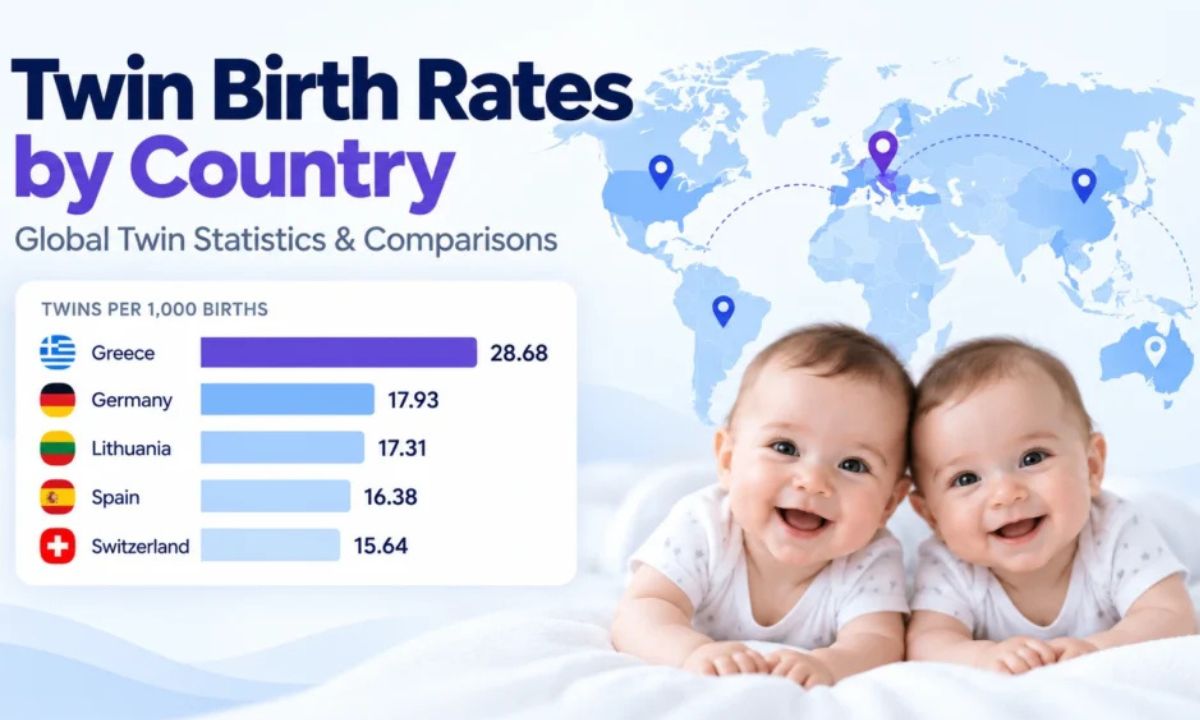
Twins have fascinated families, researchers and medical professionals for generations. While twin pregnancies occur in every part of the world, they are not distributed evenly. Some countries and populations experience noticeably higher rates of twin births than others, and those differences can be influenced by a combination of biology, maternal age, genetics, fertility treatment and reproductive trends.
Understanding why twins are more common in certain places requires looking beyond simple birth statistics. Identical and fraternal twins develop in different ways, and the factors that increase the likelihood of one type do not necessarily affect the other.
From hereditary influences to assisted reproductive technology, several variables can shape the probability of a multiple pregnancy.
How Common Are Twin Births?
Twin births represent a relatively small proportion of pregnancies worldwide, but their frequency varies considerably between countries and demographic groups.
Researchers often measure this using the twinning rate, which describes the number of twin deliveries or twin births within a particular population. Comparing twin birth rates by country reveals that some regions consistently record higher levels of twinning than others.
These differences can emerge from several factors, including:
- maternal age
- genetics and family history
- ethnicity and population characteristics
- fertility treatment
- number of previous pregnancies
- assisted reproductive technologies
- changes in the average age of motherhood
The rise of fertility treatment in many countries has also influenced multiple birth statistics over recent decades.
However, population-level twin rates should not be confused with an individual’s personal probability of conceiving twins. Personal circumstances can affect the chances considerably.
Identical and Fraternal Twins Develop Differently
One of the most important distinctions when discussing twin pregnancies is the difference between identical and fraternal twins.
Identical twins, also known as monozygotic twins, develop when a single fertilized egg divides into two embryos. Because both embryos originate from the same egg and sperm combination, identical twins usually share almost all of their genetic material.
The occurrence of identical twins appears to be relatively consistent across many populations, although the exact biological mechanisms that cause an embryo to divide are still not completely understood.
Fraternal twins, or dizygotic twins, develop differently. They occur when two separate eggs are released during the same menstrual cycle and both are fertilized.
This process is sometimes called double ovulation or multiple ovulation.
Fraternal twinning is much more strongly associated with maternal characteristics, genetics and reproductive factors. As a result, differences in fraternal twin rates contribute significantly to variations in twin birth rates between populations.
Does Having Twins Run in Families?
The idea that twins “run in families” contains some truth, but it needs an important qualification.
A family history of fraternal twins can be associated with an increased tendency toward multiple ovulation. If a woman has inherited a biological tendency to release more than one egg during ovulation, she may have a higher chance of conceiving fraternal twins.
This does not mean twins follow a simple inheritance pattern, though.
Many factors affect conception, and having twins somewhere in the family tree does not guarantee that another twin pregnancy will occur.
Identical twins are different. They result from the splitting of one fertilized egg rather than the fertilization of two separate eggs, so family history appears to play a much smaller role.
For families curious about their individual circumstances, tools that estimate the odds of having twins can help illustrate how factors such as age, fertility treatment, family history and previous pregnancies may influence probability.
Such estimates should be viewed as educational rather than as medical predictions, since conception remains influenced by many biological variables.
Maternal Age Can Affect the Chance of Fraternal Twins
Maternal age is one of the better-known factors associated with fraternal twinning.
As women move through their reproductive years, hormonal changes can affect ovulation. In some cases, these changes may increase the likelihood that more than one egg is released during a cycle.
If two eggs are released and both are fertilized, a fraternal twin pregnancy can occur.
This is one reason twin birth rates may be affected by broader demographic trends. In societies where women increasingly have children later in life, changes in maternal age can contribute to changes in the overall rate of multiple births.
Age alone, however, does not determine whether someone will conceive twins. Fertility, ovarian function and hormone levels vary significantly between individuals.
Previous Pregnancies May Also Play a Role
Women who have previously been pregnant may sometimes have a slightly higher likelihood of conceiving twins compared with women experiencing their first pregnancy.
The relationship is not straightforward, since previous pregnancy often overlaps with other factors such as age.
For example, someone who has already had several children is also likely to be older than someone having a first child. Both reproductive history and maternal age may therefore contribute to the observed differences.
This demonstrates why twin conception should rarely be attributed to a single factor.
Instead, researchers look at combinations of reproductive, genetic and demographic characteristics.
Fertility Treatment Has Changed Twin Birth Patterns
Perhaps one of the biggest influences on modern multiple birth rates has been the growth of fertility treatment.
Treatments designed to stimulate ovulation can sometimes encourage the ovaries to release more than one egg during a menstrual cycle. If multiple eggs are fertilized, the possibility of twins or higher-order multiple pregnancies may increase.
Assisted reproductive technologies such as in vitro fertilization, commonly known as IVF, have also historically been associated with multiple pregnancies.
During IVF, eggs are fertilized outside the body before one or more embryos are transferred to the uterus. In earlier decades, transferring multiple embryos was more common because it could increase the probability of pregnancy.
However, transferring multiple embryos also raises the chance of twins.
Modern fertility practice has increasingly emphasized single-embryo transfer where medically appropriate. Advances in embryo selection, laboratory techniques and reproductive medicine have therefore helped reduce some treatment-related multiple pregnancies.
Even so, fertility treatment remains an important factor when researchers examine changes in twin birth statistics.
Geography and Population Background Matter
One of the most interesting features of twin birth research is the geographical variation.
Historically, certain populations have shown substantially higher fraternal twinning rates than others. These patterns suggest that genetics, reproductive biology and environmental influences may all contribute.
Diet and lifestyle have sometimes been proposed as explanations for regional differences, although such claims can easily become exaggerated.
In most cases, scientists are cautious about attributing high twin rates to one particular food or cultural practice.
Population genetics provide a more plausible explanation for some persistent regional patterns, particularly when a greater tendency toward multiple ovulation appears across generations.
However, migration, changing maternal age and access to reproductive healthcare can gradually alter local twin statistics.
For that reason, twinning rates are not necessarily fixed characteristics of a country or population.
Can Lifestyle Increase the Chance of Twins?
The internet contains countless claims about foods, supplements and lifestyle habits supposedly capable of increasing the likelihood of twins.
Many of these claims are based on weak evidence, coincidence or observations that do not establish cause and effect.
Human reproduction is complex. While nutrition and overall health certainly affect fertility, there is no reliable lifestyle formula that guarantees twin conception.
The strongest known influences on fraternal twinning remain factors such as reproductive biology, maternal age, genetics and certain fertility treatments.
Anyone actively trying to conceive should therefore be cautious about advice promising a specific pregnancy outcome.
Twin Pregnancy Requires Additional Medical Monitoring
Although twins can result in healthy pregnancies and healthy babies, a multiple pregnancy generally requires closer medical observation than a singleton pregnancy.
Carrying two babies places additional demands on the body and can be associated with higher rates of complications such as premature birth and low birth weight.
Prenatal care is therefore especially important.
Healthcare professionals may recommend additional ultrasound examinations and closer monitoring of fetal growth, maternal health and the development of the placenta.
The type of twin pregnancy also matters.
Some identical twins share a placenta or amniotic structures, while others develop separately. Doctors use ultrasound imaging to determine these characteristics because they can influence how the pregnancy is monitored.
Population Statistics Cannot Predict an Individual Pregnancy
Twin birth data can reveal fascinating patterns, but statistics should always be interpreted carefully.
A country with a high twinning rate does not mean every person living there has a high chance of conceiving twins. Likewise, living in a country with a lower rate does not mean a twin pregnancy is unlikely for everyone.
Individual probability depends on a combination of personal factors.
These can include:
- age
- reproductive history
- family history
- ovulation patterns
- natural conception or fertility treatment
- number of embryos transferred during IVF
- other biological characteristics
Even when several factors are present, pregnancy outcomes cannot be predicted with certainty.
Probability describes likelihood, not destiny.
Why Twin Birth Rates Continue to Change
Twin birth rates are not static.
As societies change, reproductive patterns change too. People may have children later, fertility treatment may become more widely available, and medical guidelines around assisted reproduction may evolve.
All of these developments can influence the number of twin pregnancies recorded within a population.
At the same time, improvements in reproductive medicine are giving researchers a clearer picture of the biological mechanisms behind multiple conception.
The result is a much more nuanced understanding of twinning than the traditional idea that having twins is simply a matter of luck or family history.
Genetics can matter. Age can matter. Fertility treatment can matter. Population background can matter.
But no single factor tells the whole story.
Ultimately, twin pregnancies demonstrate just how complex human reproduction can be. Studying their occurrence not only helps explain why twins are more common in some families and countries, but also provides valuable insight into fertility, ovulation, genetics and reproductive health more broadly.