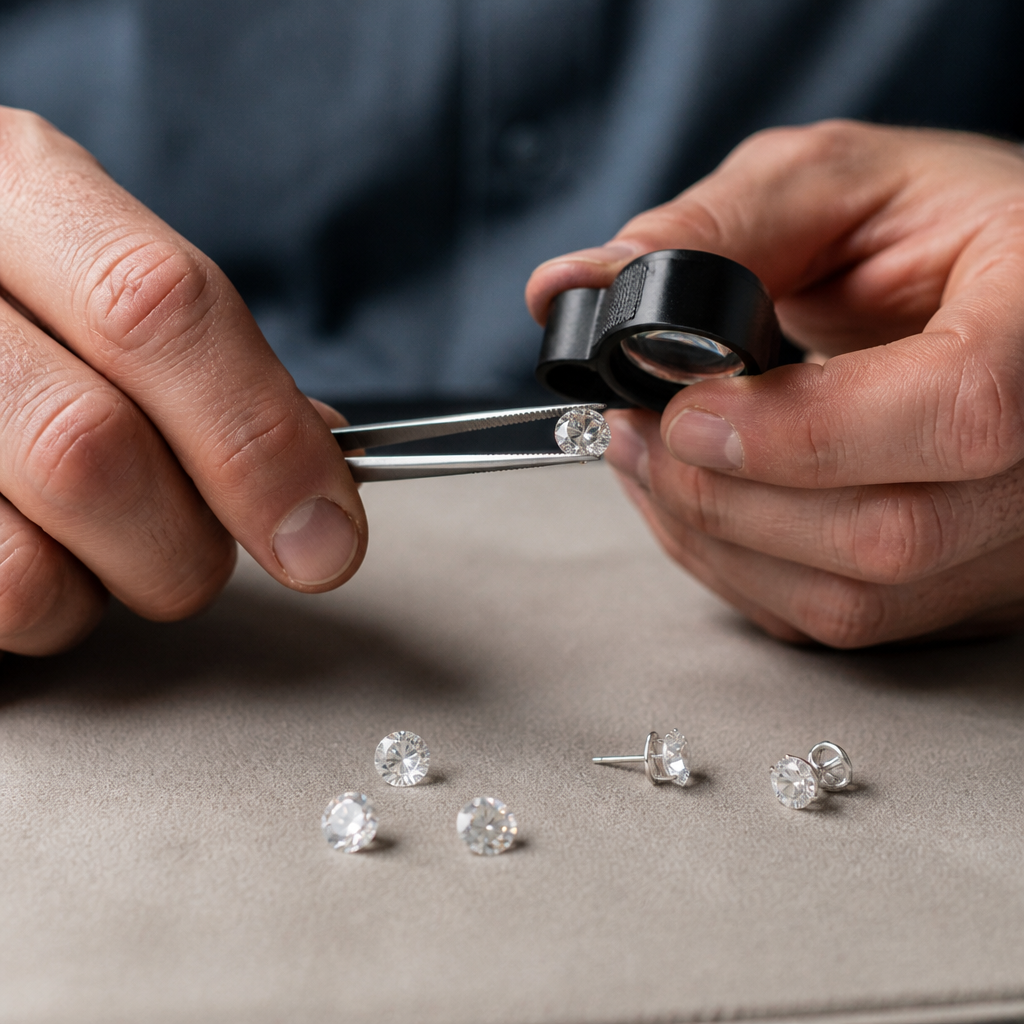
Diamond studs are the most bought and least understood piece of jewelry in the box. They look simple, which is exactly why people get them wrong: shoppers fixate on carat weight, ignore the setting, and end up with a pair that sits badly, sparkles dully or loosens within a year. The good news is that studs reward a small amount of homework more than almost any other category. Here is what actually matters, in the order it matters.
Start with the face-up size, not the carat weight
Carat is a measure of weight, not of visible spread. Two stones of identical weight can look noticeably different on the ear depending on how the cutter distributed that weight — a deep stone hides mass in the pavilion, a well-proportioned one puts it where you can see it. Because an earring is viewed almost entirely from the front and at an angle, face-up diameter is the honest number.
As a rough guide, a pair in the region of 0.70ctw reads as a refined everyday stud that sits neatly against the lobe. Move towards the middle range and you get the classic “noticeable but not shouting” look that suits most office and evening wear. Towards the 3.55ctw end, you are into statement territory, where weight, post strength and ear anatomy all become practical considerations rather than theoretical ones. Try on something in that range before committing; heavy studs on a soft lobe will tilt forward no matter how beautiful the stone.
Cut quality does the heavy lifting
In a ring, you see the stone from every angle and in changing light. In an earring, you mostly see it in motion, briefly, from the side. That makes brightness more valuable than theoretical perfection. A round brilliant with crisp, even facets will flash across a room; a sleepy, over-deep stone of the same weight will look like glass under office lighting.
Step cuts behave differently and are worth understanding before you dismiss them. Princess cuts hold their square outline and give a sharper, more architectural flash — good for anyone who finds rounds too soft. Baguettes produce long, glassy flashes rather than scintillation, which is why they work so well as accents framing a central stone or running along a cluster. If you like a clean, tailored look, a design that pairs a brilliant centre with baguette shoulders usually photographs better than a plain solitaire of similar overall weight.
Colour and clarity: where to spend less
Earrings are the one place where you can reasonably relax. You will never see the two stones side by side, your hair and skin tone shift the perceived colour, and inclusions that would bother you on a hand at arm’s length are invisible on a lobe. Spend on cut and spread; take the sensible compromise on the paperwork grades. The exception is a cluster or halo design, where a visibly off stone next to brighter accents will look muddy.
The setting decides whether you keep wearing them
This is the part people skip and regret. A four-prong martini setting sits low and flat, which is comfortable under headphones and pillows but exposes the girdle to knocks. A basket setting is taller and more protective, with a more traditional profile. Bezels — a continuous rim of metal — are the safest for very active wear and for children or anyone who catches jewelry on knitwear, at the cost of a little brightness.
Backs matter just as much. Friction posts are fine for occasional wear but loosen; screw backs are far more secure for stones you would be upset to lose, and locking backs sit somewhere between. If you plan to sleep in your studs, say so when you buy — it changes the recommendation entirely.
White gold, karat choice and real-world durability
14K and 18K white gold both make excellent stud mounts, and the choice is a genuine trade-off rather than a question of quality. 14K is harder and holds prong tension well, which suits thin, delicate mounts and daily wear. 18K carries more gold content and has a slightly richer, softer character under the rhodium finish. Either way, white gold is plated and will eventually want refinishing — that is normal, not a defect, and worth knowing before you panic at the first warm tint around the prongs.
Colour, gemstone accents and fancy diamonds
Colour is where studs stop being a default purchase and start being a personal one. Emerald, ruby and sapphire accents around a diamond centre give a stud a distinct identity and read as deliberate rather than generic — useful if the recipient already owns a plain pair. Fancy color diamonds are the other route: more subtle than coloured gemstones, with a diamond’s brightness intact. Interest in coloured stones has broadened well beyond the collector market in recent years, something the Financial Times has tracked in its coverage of shifting demand across the diamond and gemstone trade. For a gift, colour is also a quiet way to signal thought: a birthstone accent costs nothing in sparkle and a great deal in meaning.
Where to shop, and what to ask
Breadth of selection matters more than it sounds, because studs are a fit decision as much as a stone decision. Retailers that specialise rather than dabble tend to carry the same design across several weights, so you can hold a 1-carat-total and a larger pair in the same setting and judge them properly. fine diamond jewelry from Leon Diamond is a useful reference point here: the New York showroom on West 47th Street in the diamond district can be visited by appointment, and the current focus collection runs to more than 25 stud earring designs in 14K and 18K white gold — solitaire rounds, clusters, clover and heart motifs, and square styles with gemstone accents — alongside pendants, diamond cross necklaces, tennis bracelets and fancy color diamond earrings. Online shoppers get free shipping with a returns and exchanges policy, and multiple currency options, which makes comparing two weights at home realistic rather than a gamble.
Whatever the source, ask four questions: what is the face-up measurement in millimetres, what setting type and back are fitted, what karat and finish is the metal, and what documentation accompanies the stones. A seller who answers all four without hesitation is a seller worth buying from.
Living with them afterwards
Studs collect skin oils, hair product and soap faster than any other piece, and a film on the pavilion kills brilliance long before anything is actually wrong. Warm water, a drop of washing-up liquid and a soft brush once a fortnight restores most of it. Check prong tension with a fingernail every few months; a stone that rocks is a stone on its way out.
Storage is the other half of it. Keep pairs separated so stones cannot abrade each other, and store screw backs threaded rather than loose in a drawer. For anyone building a genuine collection — or a business keeping stock, records and seasonal inventory off the premises — the logic is the same as the case for organised commercial storage for growing businesses: valuables survive longest when they have a dedicated, secure, climate-sensible home rather than whatever space happens to be free.
The short version
- Judge spread in millimetres before you judge carat weight.
- Pay for cut quality; compromise sensibly on colour and clarity.
- Match setting and back to how the earrings will actually be worn.
- Treat 14K versus 18K as a durability-versus-character choice, not a ranking.
- Use colour — gemstone accents or fancy diamonds — when you want a pair that is recognisably someone’s own.
Buy on that basis and a pair of studs stops being a safe default gift and becomes the piece that gets worn every day for twenty years — which is, in the end, the only measure of value that holds up.