Custom apparel has become much easier to enter than it once was.
A small business can now create artwork digitally, sell through an online store, take personalized orders, and produce short runs without committing to huge quantities of stock. For creators, print shops, local businesses, and online sellers, that flexibility creates opportunities—but it also creates a new decision.
Which printing technology actually fits the business?
Two options that frequently appear in custom garment production are direct-to-film and direct-to-garment printing.
They may sound similar because both begin with digital artwork, but they serve different workflows.
For a growing business, choosing between them should not come down to which technology is newer, more popular, or more heavily promoted. The more useful questions are:
· What products do you plan to sell?
· Which fabrics will you use most?
· How many orders will you process?
· How much production space do you have?
· How important is flexibility across different garment types?
· What kind of finish do customers expect?
Understanding these factors makes it much easier to decide whether DTF, DTG, or a combination of the two makes sense.
Start With the Product, Not the Printer
One of the most common mistakes in print equipment purchasing is choosing the machine first and figuring out the product strategy later.
The better approach is the opposite.
Start by listing what the business intends to produce.
That could include:
· T-shirts
· Hoodies
· Sweatshirts
· Tote bags
· Teamwear
· Event merchandise
· Personalized clothing
· Small brand collections
· Promotional apparel
Then think about the fabrics involved.
A shop focused heavily on cotton garments may have different priorities from one that wants to print across a wider mix of polyester, blends, nylon, denim, canvas, and other materials.
Procolored’s current EU product information reflects this difference quite clearly.
Its DTF category describes direct-to-film printing as a transfer-based process designed for a broad range of fabrics, including cotton, polyester, blends, spandex, nylon, denim, and canvas. Its DTG page, by contrast, describes direct-to-garment printing as better suited to garments with a high cotton content.
That immediately creates one of the biggest distinctions between the two methods.
What DTF Printing Changes in the Workflow
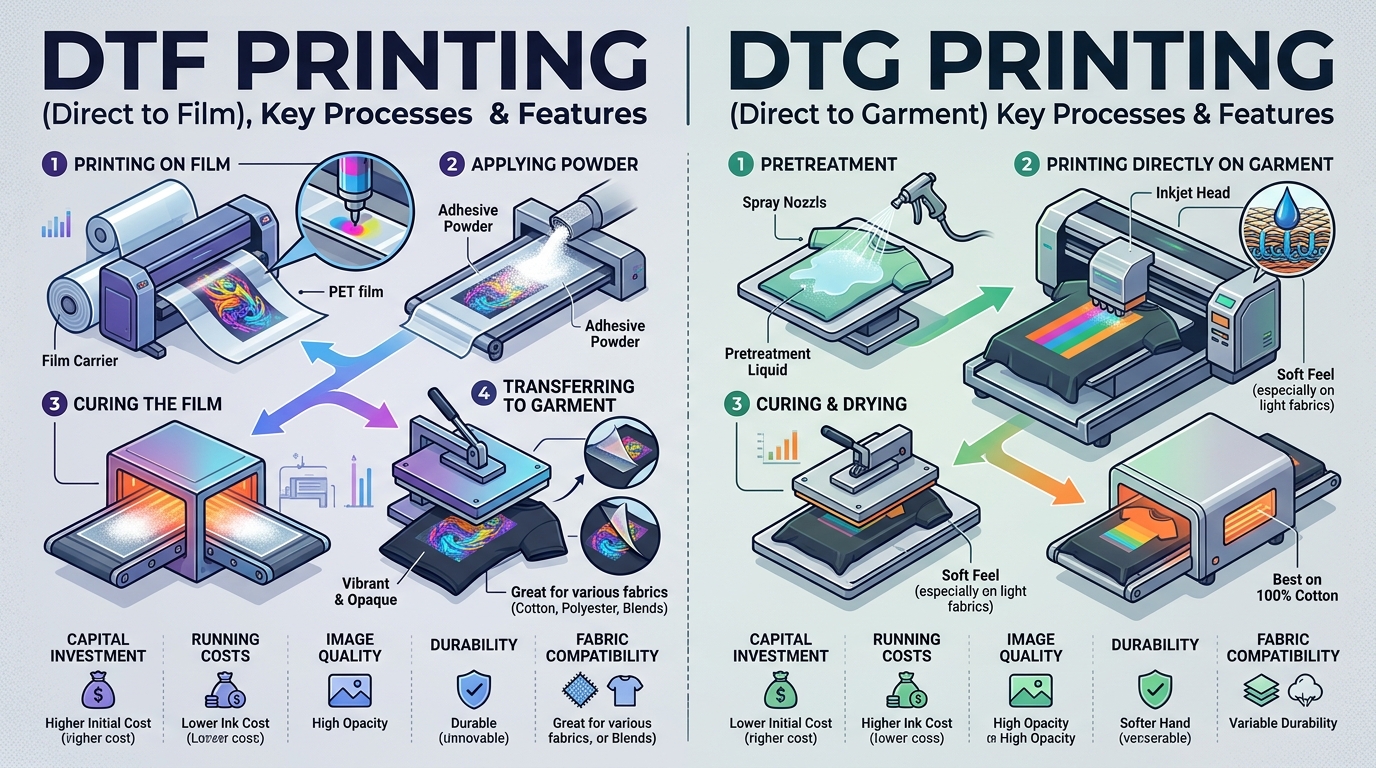
With direct-to-film printing, the design is first printed onto transfer film.
The printed film then goes through an adhesive and curing stage before the design is transferred to the garment using heat.
That means the printer is only one part of the workflow.
A DTF production area may also need space for:
· Transfer film
· DTF ink
· Adhesive powder
· Curing equipment
· Heat pressing
· Finished transfer storage
· Blank garments
For businesses that want flexibility across different garment types, this additional workflow can be worthwhile.
A modern DTF printer can be particularly useful where the shop wants to produce designs for a broad range of textiles rather than concentrating primarily on cotton garments.
Procolored.eu’s current DTF range includes compact A4 systems as well as multiple 13-inch/A3-class machines. The collection currently includes F8, F13, F13 Pro, K13 Lite and P13 families, giving businesses different choices in print width and configuration.
The important point is not that one model is automatically right for every shop.
It is that DTF can support a flexible product strategy when the business expects to print on varied fabrics.
How DTG Printing Differs
Direct-to-garment printing removes the transfer-film stage.
Instead, the design is printed directly onto the garment.
This can make the workflow feel more straightforward for businesses that primarily print suitable fabric garments and want the design applied directly to the textile.
Procolored.eu currently describes DTG as a digital printing method that prints directly onto fabrics and says its DTG equipment is better suited to garments containing more than 80% cotton. Its present EU range includes the T8 Panda A4 model and T11 Pro A3 model.
A DTG printer may therefore make sense for businesses focused primarily on cotton T-shirts, hoodies, and similar apparel.
The production decision becomes less about which technology is universally better and more about which workflow matches the shop’s most common order.
Fabric Choice Is One of the Biggest Differences
Fabric compatibility is one of the first things a buyer should evaluate.
If your business plans to print on a wide mix of textiles, DTF offers more flexibility because the printed design is transferred onto the material rather than printed directly into the garment fibers.
That can be useful for businesses producing:
· Sportswear
· Workwear
· Polyester garments
· Cotton-poly blends
· Canvas accessories
· Denim items
· Personalized merchandise
DTG makes more sense when the business has a narrower focus on high-cotton garments.
For example, a premium cotton T-shirt brand may value a direct-to-garment workflow because the printing method aligns well with the type of blanks already being used.
A custom shop taking many different product requests, however, may find wider fabric compatibility more important.
This is why the product catalog should come before the machine purchase.
Consider Print Size Early
Print width matters because it directly affects what kinds of graphics can be produced efficiently.
Small logos and chest graphics require less printing area.
Large front graphics, back prints, and hoodie designs need more.
Procolored.eu currently offers DTF systems ranging from smaller A4 formats up to 13-inch/A3-class models. Its DTF collection currently contains many 13-inch systems, while its DTG range includes the smaller T8 and larger T11 Pro.
For a startup, buying the largest format simply because it exists may not be necessary.
Instead, look at the artwork customers are actually ordering.
If most jobs are logos, names, and smaller graphics, compact equipment may be enough.
If the business frequently produces full-front designs, a larger format could reduce workflow limitations.
Small-Batch Production Changes the Equation
Digital garment printing becomes especially attractive when the business does not want to hold large amounts of finished inventory.
Instead of producing hundreds of identical pieces, a company can respond to demand in smaller batches.
That creates opportunities for:
· Limited collections
· Personalized apparel
· Event merchandise
· Creator merchandise
· Local teamwear
· Test products
· Seasonal releases
In this environment, flexibility can be more valuable than maximum production capacity.
A small shop may not need the fastest possible machine.
It may need a setup that lets one operator move smoothly from artwork to finished garment without excessive waste or setup complexity.
That is where DTF and DTG both have roles.
DTF Can Suit a Broader Product Mix
Imagine a business that accepts customer orders across different garment types.
One customer wants cotton T-shirts.
Another wants polyester team shirts.
Another wants tote bags.
Another wants a design on a blended hoodie.
A transfer-based DTF workflow can simplify that variety because the business is not relying on the same direct fabric-printing behavior for every material.
Procolored.eu currently markets its DTF category specifically around broad textile compatibility.
For a print shop that values product diversity, that can be a significant advantage.
It also means the business can test new categories without replacing the entire printing system.
DTG Can Suit a More Focused Apparel Brand
Now imagine a different business.
This company sells its own premium cotton T-shirt collection.
The garment range is controlled.
The blank material is consistent.
The designs are produced repeatedly on similar products.
In this case, direct-to-garment printing may fit the workflow well.
Because the design is printed directly onto the garment, the production process can remain centered around a relatively narrow product category.
This can appeal to businesses where:
· Cotton is the main material
· The garment range is standardized
· Design quality is closely tied to the fabric
· The company controls its blank inventory
· Most orders use similar products
The decision therefore depends heavily on whether the business is broad and service-oriented or focused and brand-oriented.
Workspace Requirements Should Not Be Ignored
Equipment purchasing is not only a technical decision.
It is also a space-planning decision.
A DTF setup may involve separate stages for printing, powder application, curing, and heat pressing.
A DTG setup may require room for pretreatment depending on the garment and workflow, along with drying or pressing and direct printing.
Before ordering equipment, map the process physically.
Ask:
Where will the blank garments be stored?
Where will artwork be prepared?
Where will printing happen?
Where will transfers or garments move next?
Where will finished products be inspected?
Where will packing happen?
A machine can fit into a room while the production process does not.
The most efficient setup is usually one in which the product moves in a logical direction from blank garment to finished order.
Maintenance Matters More Than Marketing
A printer that sits at the center of a small business needs regular care.
That is true whether the business chooses DTF or DTG.
Before buying, check:
· Cleaning requirements
· Ink-management systems
· Recommended operating frequency
· Printhead maintenance
· Consumable replacement
· Software support
· Spare-parts availability
· Technical assistance
Procolored’s current machine comparison and collection pages show that its printer families use different printheads, print sizes, and configurations. That means maintenance expectations should be checked at model level rather than assuming every machine behaves the same way.
For a small operation, downtime can be especially disruptive because there may be no second machine available to take over production.
Maintenance should therefore be treated as part of the cost of ownership.
Think About the Entire Cost per Order
Printer price is easy to see.
The real cost of production is more complicated.
A business should account for:
· Ink
· Film
· Adhesive powder where applicable
· Pretreatment where applicable
· Blank garments
· Heat pressing
· Electricity
· Maintenance
· Cleaning
· Failed prints
· Labor
· Packaging
· Shipping
· Marketplace fees
Two printers with very different purchase prices can end up producing very different business economics.
The cheaper machine is not automatically the better choice if it creates unnecessary waste or does not support the products customers want.
Likewise, the more expensive machine is not automatically the better investment if most of its capacity goes unused.
The goal is not to own impressive equipment.
The goal is to produce profitable orders reliably.
Do Not Buy for Future Demand That Does Not Exist Yet
New businesses often overestimate how quickly order volume will grow.
That can lead to oversized equipment purchases.
It is reasonable to plan for expansion, but expansion should be based on realistic sales expectations.
For a startup, capital may also be needed for:
· Website development
· Advertising
· Product photography
· Blank garments
· Packaging
· Samples
· Marketplace fees
· Branding
· Shipping
Spending too much on production capacity before demand exists can leave too little budget for actually acquiring customers.
A better strategy is often to select equipment that supports current demand with some room for growth.
Then upgrade when order volume proves the need.
Test Real Products Before Committing to a Large Range
Before building a huge product catalog, produce samples.
Use the actual materials the business plans to sell.
Test different artwork types.
Evaluate:
· Fine details
· Large solid areas
· Colour consistency
· Placement
· Garment feel
· Wash performance
· Production time
· Repeatability
This is particularly important when comparing DTF and DTG because the result depends not only on the printer but also on the garment, ink system, workflow, and finishing process.
A test based on real products is more useful than comparing specification sheets alone.
Standardise the Workflow
Once the business finds a process that works, document it.
Create production standards for:
· Artwork size
· File preparation
· Garment type
· Print position
· Pressing steps
· Quality checks
· Packing
The exact production settings should always follow the relevant equipment and consumable instructions.
The goal is consistency.
If the same customer returns three months later and orders the same design, the business should be able to reproduce it without relying entirely on memory.
Could a Business Use Both DTF and DTG?
Yes, but only if demand justifies it.
A larger or more diversified shop might use DTF for flexible textile applications and DTG for specific cotton garment workflows.
That does not mean a new business should immediately buy both.
It means the two technologies are not necessarily competitors in every environment.
They can serve different jobs.
Procolored.eu currently sells both categories side by side, along with UV and UV DTF equipment, which reflects how digital-print businesses may eventually build more than one production capability.
For a startup, however, simplicity has value.
Learning one workflow thoroughly is often more useful than managing several technologies before enough orders exist to support them.
A Simple Way to Choose
A business can narrow the decision by asking a few practical questions.
Choose DTF as the stronger candidate if:
· You want to print on a broader mix of fabrics.
· Your product range changes frequently.
· You sell personalized or varied apparel.
· You want transfer-based production flexibility.
· Polyester and blended fabrics are important.
Consider DTG more seriously if:
· Cotton garments dominate your product range.
· You mainly print T-shirts and similar apparel.
· You control the garment selection closely.
· Direct printing onto the garment fits your workflow.
· Your product catalog is relatively consistent.
These are not absolute rules.
They are starting points.
Real production testing should still guide the final purchase.
Final Thoughts
The choice between DTF and DTG is not really a competition between two acronyms.
It is a business-model decision.
DTF offers flexibility across a wider range of textiles and can work well for businesses that handle diverse custom orders.
DTG can make sense for operations focused more heavily on cotton garments and direct-to-garment production.
Procolored.eu currently offers both categories, from compact DTF systems to 13-inch models and from the T8 to the larger T11 Pro DTG platform, giving European buyers several formats to compare.
The smartest approach is to avoid buying on specifications alone.
Start with the garments.
Look at the fabrics.
Estimate realistic order volume.
Measure the available workspace.
Understand the maintenance requirements.
Calculate the real cost per finished product.
Then choose the technology that fits the way the business actually plans to operate.
For a custom apparel company, the right printer is not necessarily the biggest or most expensive one.
It is the one that supports a repeatable production process and the products customers genuinely want to buy.